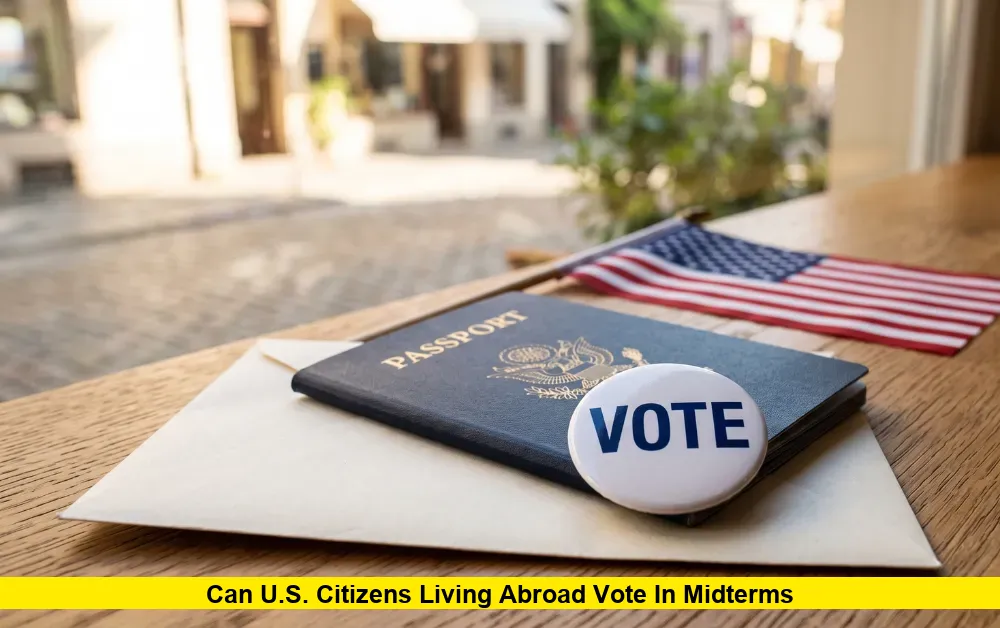
Can U.S. citizens living abroad vote in midterms? Yes. Most eligible U.S. citizens who live outside the country can participate in federal midterm elections through absentee voting, even if they have lived overseas for many years. The process allows Americans to vote for federal candidates without traveling back to the United States, although registration requirements, ballot return methods, and deadlines depend on the state or territory where each voter is eligible to register.
The 2026 U.S. midterm general election is scheduled for Tuesday, November 3, 2026. With Election Day approaching, Americans living in countries such as Canada, the United Kingdom, France, Germany, Australia, Japan, and other destinations should check their voting status and determine whether they still need to request or return an absentee ballot.
Overseas voting is different from voting at a polling station in the United States. Instead of visiting a local polling place, eligible citizens generally use a state-administered absentee voting process. The Federal Post Card Application, commonly known as the FPCA, allows many overseas voters to register and request an absentee ballot through a single application.
However, citizenship alone does not settle every eligibility question. A voter’s previous U.S. residence, age, registration status, state law, and the type of election can affect which contests appear on the ballot and how the ballot must be returned.
Understanding these requirements can help Americans abroad participate in the 2026 midterms while avoiding common mistakes that could prevent a ballot from being counted.
What Are the 2026 U.S. Midterm Elections?
Midterm elections take place halfway through a president’s four-year term. They give voters an opportunity to elect members of Congress and participate in other elections scheduled by their states and local jurisdictions.
The 2026 midterms are particularly important for determining the composition of the U.S. Congress. All 435 seats in the House of Representatives are scheduled for election, along with approximately one-third of the Senate’s seats. Depending on the state, voters may also choose governors, state legislators, attorneys general, judges, local officials, or decide ballot measures.
For Americans living abroad, the specific races available depend on their voting residence in the United States. Someone whose last eligible residence was in Ohio will not receive the same ballot as someone whose voting residence is in California or Texas.
The fact that a voter lives overseas does not, by itself, remove eligibility to participate in federal elections. The Uniformed and Overseas Citizens Absentee Voting Act, commonly called UOCAVA, establishes protections for eligible overseas citizens and certain other groups so they can register and vote absentee in federal elections. Most states and territories also provide absentee voting opportunities for eligible overseas citizens in state and local elections.
The important distinction is that federal voting eligibility and eligibility for every state or local contest are not always identical. State law determines the additional elections in which an overseas voter may participate.
Can Americans Living Abroad Vote Without Returning to the United States?
Yes. Eligible U.S. citizens generally do not need to travel to America to cast a ballot in the midterm elections. They can use the absentee voting process administered by their state or local election office.
This applies to many different circumstances, including Americans who have moved overseas for employment, retired abroad, enrolled in an international university, joined a spouse living in another country, or relocated for personal reasons.
The same general principle applies to many U.S. citizens temporarily traveling abroad during an election. A person does not necessarily lose voting eligibility simply because they are outside the country on Election Day.
Overseas voters should distinguish between three parts of the process:
- Registration: Establishing or confirming eligibility with the appropriate election office.
- Ballot request: Asking election officials to provide an absentee ballot for the relevant elections.
- Ballot return: Completing the ballot and submitting it according to the state’s approved procedures and deadlines.
In many states, the FPCA can handle registration and the absentee ballot request together. Once an election office approves the application, it can provide the ballot using an available delivery method.
This means an American living in another country can participate without appearing in person at a U.S. polling station. However, the voter must still complete the required paperwork correctly and follow the rules for the state where they are registered or eligible to vote.
Who Is Eligible to Vote in the 2026 Midterms From Abroad?
Most U.S. citizens aged 18 or older who reside overseas can vote absentee in federal primary and general elections, provided they satisfy the applicable eligibility and registration requirements. Certain younger citizens may also be able to participate in primaries under state-specific rules.
Eligibility generally depends on citizenship, age, the voter’s qualifying voting residence, and compliance with the applicable election procedures.
U.S. citizens who moved abroad permanently
Americans who have established their lives in another country may remain eligible to vote in U.S. federal elections. Moving overseas does not automatically cancel their voting rights.
For voting purposes, the relevant residence is generally the state where the person was last domiciled before leaving the United States. A voter does not necessarily need to own property there, maintain a current residential lease, or plan to return to the same state.
This distinction is important for retirees and long-term expatriates. Someone who moved overseas many years ago should not assume that the passage of time alone makes them ineligible.
Nevertheless, the voter should verify the registration rules of the relevant state rather than assume that a previous registration remains active indefinitely.
Americans temporarily living overseas
U.S. citizens studying abroad, working on temporary assignments, traveling for an extended period, or spending time outside the country may also qualify for absentee voting.
For example, an American university student attending a semester-long program in Spain may be eligible to vote using their qualifying U.S. voting residence. An employee assigned to a project in Singapore may likewise be able to request an absentee ballot.
The length of the overseas stay does not, by itself, answer every voting-residence question. The appropriate election office can explain how to complete the application and which address to use.
Military personnel and eligible family members
Members of the U.S. uniformed services serving outside their voting jurisdiction, eligible family members, and other groups covered by UOCAVA have specific absentee voting protections.
Military voters and civilian U.S. citizens living abroad use related federal procedures, although their individual circumstances and administrative assistance may differ.
The Federal Voting Assistance Program provides information and resources for eligible military voters, their families, and overseas citizens.
U.S. citizens born abroad
Citizenship acquired at birth outside the United States does not automatically mean that a person is excluded from overseas voting. However, citizens born abroad who have never lived in the United States face a more complicated question.
Their eligibility depends on the law of the state connected to their family voting residence. Some states permit these citizens to register and vote using a qualifying parent’s or legal guardian’s last U.S. residence. Other states impose different requirements or may not permit voting under those circumstances.
Anyone who has never personally lived in the United States should investigate this issue before assuming they qualify. The rules for this group are not uniform nationwide.
How to Register to Vote From Abroad in 2026
For most overseas voters, the first practical step is to consult the Federal Voting Assistance Program, or FVAP. Its official resources explain how to identify the appropriate election office, complete the required forms, and follow state-specific instructions.
The process can generally be divided into the following steps.
Step 1: Identify your U.S. voting residence
Begin by identifying the state and address where you last lived before moving abroad. This is generally the address used to establish your voting residence, rather than your current home in another country.
Your voting residence helps election officials determine which congressional district, state legislative district, and other jurisdictions apply to you.
If you no longer remember your previous address, consider checking old tax records, previous voter registration documents, archived correspondence, or other personal records. Your former election office may also be able to help you locate your registration information.
Do not replace the U.S. voting residence with your overseas mailing address. The application normally distinguishes between the two because they serve different purposes.
Step 2: Complete the Federal Post Card Application
The Federal Post Card Application is widely used by overseas voters to register and request absentee ballots.
The form asks for information needed to identify the voter and determine the appropriate voting jurisdiction. Depending on the applicable instructions, this may include your full name, voting residence, current overseas address, contact details, and other eligibility information.
Read the instructions for your state carefully before submitting the application. An incomplete form, missing signature, incorrect address, or other error may require additional communication with election officials.
Use the current form and official guidance available through FVAP. If your state provides a separate online registration or ballot request procedure for overseas citizens, follow the applicable official instructions.
Step 3: Submit the application to the correct election office
The FPCA must be sent to the relevant state or local election officials, not simply to a U.S. embassy or to FVAP for processing.
Depending on the state, the application may be submitted by mail, email, fax, or another permitted method. The available options and any document requirements vary.
An application that is correctly completed but delivered to the wrong office may not be processed as intended. Confirm the recipient and submission method using your state’s official voting guidance.
Step 4: Check your registration status
After submitting the application, check whether the election office has received and processed it.
Some states provide online voter registration or absentee ballot tracking tools. In other cases, voters may need to contact the local election office directly.
Do not assume that submitting a form automatically means your ballot request has been approved. If the election office needs additional information, responding promptly may be especially important when Election Day is approaching.
Step 5: Follow the ballot instructions when it arrives
Once your application has been processed, the election office can provide the appropriate ballot through a permitted delivery method.
Read the instructions before marking the ballot. Make sure you understand how to identify your choices, complete any required declarations, sign the necessary documents, and prepare the ballot for return.
Even if you have voted from abroad before, review the current instructions for the 2026 election. Procedures and deadlines may change between election cycles.
What Is the Federal Post Card Application (FPCA)?
The Federal Post Card Application is one of the central tools for overseas voting. It allows eligible citizens covered by UOCAVA to register to vote and request an absentee ballot through a standardized federal application.
For many voters, its main advantage is that it combines two important steps. Rather than navigating separate processes for registration and ballot requests, eligible overseas citizens can often complete both through the FPCA.
The form also helps election officials identify the correct voting residence and communicate with the voter about their application.
Why the FPCA matters for overseas Americans
International voting involves additional logistical challenges. A voter may live thousands of miles from the election office, use a different postal system, or face delays in receiving official documents.
The FPCA helps establish the information needed to administer absentee voting without requiring the voter to return to the United States.
It also allows the voter to provide current contact information so officials can communicate about the application or ballot.
Do you need to submit a new FPCA every year?
The U.S. Department of State advises overseas citizens to submit an FPCA each calendar year in which they wish to vote. A new application is also recommended whenever the voter moves or changes their name, mailing address, or email address.
This is important because an application from a previous election year may not cover the current election cycle.
For the 2026 midterms, voters who have not yet completed the process should check their status immediately. Those who already submitted an application should verify that the election office has received it and that their contact information is correct.
Can the FPCA be submitted electronically?
Many states permit some electronic submission methods for the FPCA, but the available methods depend on state rules.
Some election offices accept applications by email or fax, while others provide online procedures or require specific forms of delivery.
Voters should not assume that an application can be submitted electronically simply because the ballot itself may be available online. Application submission and completed-ballot return are separate processes, and each has its own rules.
What Address Should Overseas Voters Use?
One of the most important details in overseas voting is the distinction between a voting residence and a mailing address.
Your voting residence generally refers to your last qualifying domicile in the United States before departing. Your mailing address is where election officials can send correspondence or ballot materials while you live abroad.
These addresses may be in different countries, and the application should identify them in the appropriate fields.
For example, an American who last lived in Colorado before relocating to Italy would generally identify the qualifying Colorado residence as the voting residence and their current Italian address as the overseas mailing address.
The correct voting residence determines the ballot associated with the voter. It can affect congressional representation, state contests, and local elections for which the voter qualifies.
What if you no longer own a home in the United States?
Not owning a U.S. home does not automatically prevent an overseas citizen from voting absentee.
The applicable voting residence may remain valid even if the person sold their former property, no longer rents an apartment in that state, or has uncertain plans to return.
The important issue is identifying the qualifying voting residence under the applicable rules, not demonstrating that the voter currently owns property there.
What if you moved several times before going abroad?
Use the residence that meets the applicable voting-residence rules, generally the state where you were last domiciled immediately before leaving the United States.
If you moved between states, spent time at temporary addresses, or are uncertain about your legal residence, consult the state’s instructions or contact the election office. Do not select a state simply because you have relatives there or because you believe its rules may be more convenient.
What if you were born abroad and never lived in the United States?
The rules can be more complex for citizens who have never established their own U.S. residence.
Depending on state law, a qualifying parent’s or legal guardian’s last U.S. residence may provide the basis for registration. Eligibility and the types of elections available differ by state.
These voters should seek state-specific guidance before completing the application rather than assume that the rules for former U.S. residents apply to them in exactly the same way.
What Is the Deadline for Overseas Voting in the 2026 Midterms?
The 2026 midterm general election is scheduled for November 3, but overseas voters should not treat Election Day as a universal deadline for completing every part of the voting process.
Registration deadlines, absentee ballot request deadlines, ballot return requirements, and accepted submission methods vary by state. Some states require ballots to arrive by a specified time, while others have different rules for particular categories of voters.
The federal government recommends that overseas voters submit their FPCA at the beginning of the calendar year or at least 45 days before an election. That recommendation gives election officials time to process the request and gives voters an opportunity to resolve problems. It does not mean that every state has the same registration deadline.
Because the November 2026 election is approaching, eligible Americans abroad who have not started the process should act promptly.
Registration and ballot request deadlines
The first deadline to investigate is the date by which your election office must receive your registration application or absentee ballot request.
Some states allow overseas voters to register and request ballots close to Election Day, while others have earlier deadlines or additional requirements. A deadline that applies to one state should never be assumed to apply nationwide.
For example, Texas has published a specific deadline of October 23, 2026, for receiving FPCAs for its November 3 general election. This is a state-specific deadline, not a nationwide cutoff.
The safest approach is to consult your own state’s current instructions rather than rely on a general deadline reported elsewhere.
Ballot return deadlines
Receiving a ballot is only part of the process. Your completed ballot must also be returned in accordance with the applicable state’s rules.
Depending on the state, the relevant deadline may involve when election officials receive the ballot, when it is postmarked, or another condition specified by law. The permitted submission method can also affect the deadline.
A ballot mailed internationally may take longer to arrive than one mailed domestically. If your state requires receipt by Election Day, posting your ballot on November 3 may be too late.
Check the official deadline and allow enough time for the ballot to reach the election office.
What if you missed an earlier deadline?
Do not automatically assume that you can no longer vote. Check the current instructions for your state to determine whether registration, an absentee ballot request, or another permitted procedure remains available.
If you are already registered but have not received your ballot, investigate the backup ballot procedures discussed below. If you have not registered, contact your election office promptly to establish whether any applicable option remains open.
The availability of a remedy depends on the voter’s circumstances and state law. There is no single deadline exception that applies to every overseas citizen.
How Do Americans Abroad Receive Their Absentee Ballots?
States provide absentee ballots through different delivery methods. Depending on the applicable rules and the voter’s request, the ballot may be delivered electronically, by fax, by international mail, or through an online download system.
Electronic delivery can be especially useful for Americans who live far from the United States or in places where international postal service is unreliable.
However, electronic ballot delivery does not necessarily mean that the completed ballot can also be returned electronically. Those are separate questions governed by state-specific procedures.
After the election office approves your request, follow its instructions for accessing the ballot. Check your email, including spam and junk folders, if electronic delivery was selected.
If the expected ballot does not arrive, contact the election office instead of waiting indefinitely. A delay may be caused by an incomplete application, a delivery issue, or another administrative problem.
Some states also provide ballot tracking services that help voters confirm whether an application or completed ballot has been received.
Can U.S. Citizens Living Abroad Vote by Email or Online?
Sometimes, but the answer depends on what part of the voting process is involved.
Many states allow overseas voters to receive blank ballots electronically. Some also permit completed ballots to be returned electronically, while others require a physical ballot to be mailed or submitted through another approved channel.
The distinction matters because downloading a ballot and returning a voted ballot are not the same action.
Electronic ballot delivery
If your state permits electronic delivery, you may receive a ballot by email, download it through an official system, or access it through another approved method.
You should follow the official instructions for printing, completing, signing, and preparing the ballot. If the state specifies a particular file format, declaration, or return procedure, follow those requirements carefully.
Electronic ballot return
Some states permit completed absentee ballots to be transmitted by email, fax, or an online system for eligible overseas voters. Other states restrict these methods.
Never assume that emailing a completed ballot is acceptable simply because you received the blank ballot electronically. An unapproved return method can prevent a ballot from being counted.
The U.S. Department of State directs overseas voters to the Federal Voting Assistance Program for state-specific guidance on permitted ballot return methods.
Returning ballots by international mail
If your state requires a physical ballot, international mail may be an option.
Check whether the election office requires a particular envelope, declaration, signature, or postage arrangement. Allow sufficient time for international delivery and consider whether local postal delays could affect your ballot.
Where a state permits alternative delivery services, compare the available options against the official rules and the remaining time before the deadline.
Can You Return an Absentee Ballot Through a U.S. Embassy or Consulate?
U.S. embassies and consulates can provide overseas voting information and, where available, assistance with transmitting voting materials. However, they are not ordinary polling places where Americans abroad can simply appear and vote in person.
The State Department explains that voters may be able to submit a properly addressed ballot through an embassy or consulate for onward transmission to the United States. The procedure, availability, and timing depend on the particular location and the instructions in effect.
Before relying on this option, check the website of the embassy or consulate responsible for your country.
Important considerations include:
- Whether the location accepts completed absentee ballots for transmission.
- How the ballot must be addressed and packaged.
- Whether a postage-paid envelope is available or additional postage is required.
- The deadline for submitting voting materials to the embassy or consulate.
- Whether enough time remains for the materials to reach the election office.
Embassy transmission should not be treated as an automatic extension of your state’s ballot return deadline. A ballot submitted too late may still miss the deadline that applies to the election.
If your state permits another return method that can reach election officials more quickly, compare the options and follow the applicable official instructions.
What Should You Do If Your Overseas Ballot Has Not Arrived?
A missing ballot can be particularly stressful when Election Day is approaching, but overseas voters may have a backup option.
The Federal Write-In Absentee Ballot, or FWAB, is designed to help eligible military and overseas voters who have requested an absentee ballot but have not received their regular ballot in time.
It is not a substitute for checking your state’s rules, and its availability depends on the applicable requirements. Nevertheless, it is an important option to understand before an election.
Understanding the Federal Write-In Absentee Ballot
The FWAB provides a way for eligible voters to cast a write-in absentee ballot when their regular ballot has not arrived in time.
The form can be used under the conditions established by federal law and the applicable state procedures. Voters generally need to complete the required application process and follow the instructions for identifying eligible contests and candidates.
Because the backup ballot may involve additional steps, use the official FVAP resources to determine whether you qualify and how to complete it.
When should you consider using the backup ballot?
The State Department advises overseas voters who have completed the required steps but have not received their ballot 30 days before an election to submit a completed FWAB.
With the November 3, 2026, election approaching, voters who requested ballots but have received nothing should check their eligibility for this option immediately.
Do not wait until the final hours before Election Day to investigate a missing ballot.
What if the regular ballot arrives after you submit the FWAB?
If your regular absentee ballot arrives after you submit the backup ballot, follow the official instructions for completing and returning the regular ballot as well.
Election officials apply the relevant rules to determine which ballot is counted. Submitting a backup ballot does not mean you should ignore a subsequently delivered regular ballot.
The key is to follow the instructions carefully and avoid attempting to cast multiple votes. Only one valid vote may be counted for the same voter in the election.
Which Elections Can Overseas Americans Vote In?
The elections available to Americans living abroad depend on their voting residence and the applicable state laws.
For most eligible overseas voters, federal elections are the central part of the process. These include congressional contests during the midterms, as well as federal primary and general elections.
State and local participation can be more complicated.
U.S. House of Representatives
All 435 seats in the House of Representatives are scheduled for election in 2026. Overseas voters who qualify can generally vote in the congressional district associated with their voting residence.
Your previous U.S. address helps determine which district’s ballot you receive. Living in another country does not mean you can choose whichever congressional district you prefer.
U.S. Senate
Approximately one-third of Senate seats are scheduled for election during each regular midterm cycle.
An eligible overseas voter can participate in a Senate race when that seat is on the ballot in the state associated with the voter’s voting residence.
Not every state has a Senate election in every midterm year. The available contest depends on the election cycle.
Governors and state legislatures
Depending on the state, overseas citizens may also be eligible to vote for governor, state legislators, and other state officials.
The rules governing these contests vary. Some states extend absentee voting to a broad range of state elections, while eligibility for certain contests may depend on additional requirements.
Local offices and ballot measures
County, municipal, judicial, and ballot-measure elections may also be available to overseas voters under state law.
However, not every local contest will necessarily appear on every overseas voter’s ballot. The voter’s voting residence and the rules governing the particular election determine eligibility.
For this reason, overseas voters should examine their official ballot when it becomes available rather than assume that it includes every federal, state, and local contest.
Do Americans Abroad Need to Pay U.S. Taxes to Vote?
Voting eligibility and tax obligations are separate matters.
A U.S. citizen living abroad may continue to have U.S. federal tax filing obligations depending on their circumstances. However, filing taxes or paying a particular amount of tax is not a general prerequisite for voting in federal elections.
Likewise, voting from abroad does not automatically settle questions about tax residency or state tax liability.
Americans who have lived overseas for a long time may have questions about how voting residence relates to domicile or tax rules. These are distinct legal concepts, even though they can sometimes involve similar facts, such as a person’s former home or plans to return to the United States.
The Federal Voting Assistance Program explains that voting in federal elections alone generally should not be treated as the sole basis for determining residence for state and local tax purposes.
Anyone with complicated tax or residency circumstances should seek appropriate tax guidance rather than assume that registering to vote will automatically change their tax status.
Can Dual Citizens Vote in the U.S. Midterms?
Holding citizenship in another country does not, by itself, automatically disqualify a person from voting in U.S. federal elections.
A dual U.S. citizen who lives overseas may generally qualify to vote absentee if they meet the applicable U.S. voting requirements.
For example, an American who also holds British, Canadian, Australian, or another country’s citizenship may still be eligible to register and vote in U.S. federal elections.
However, dual citizenship does not remove the need to follow the U.S. state’s registration and ballot procedures. The voter’s voting residence, age, registration status, and applicable state rules remain important.
Anyone who has never lived in the United States should pay particular attention to the state rules governing citizens born abroad. Their circumstances may differ from those of dual citizens who previously established a U.S. voting residence.
Common Mistakes Overseas Voters Should Avoid
Even eligible citizens can encounter difficulties if they misunderstand the absentee voting process. The following mistakes are worth avoiding during the 2026 midterm election cycle.
Waiting until Election Day to start
International mail, application processing, and ballot delivery can take time. Waiting until November 3 to begin the process can leave little opportunity to resolve a problem.
Check your registration status and ballot request as soon as possible.
Using the wrong address
Your overseas mailing address is not generally a replacement for your U.S. voting residence.
Make sure the application distinguishes between the address that establishes your voting jurisdiction and the address where you currently receive mail.
Assuming all states follow the same deadlines
State deadlines can differ considerably. A date that applies to a voter in one state may not apply to someone whose voting residence is elsewhere.
Use the official instructions for your own state rather than relying on a general deadline.
Assuming email is always an acceptable return method
Receiving a ballot electronically does not automatically authorize electronic return.
Confirm the permitted methods before sending your completed ballot. If the state requires physical delivery, follow that requirement.
Leaving required fields incomplete
Missing signatures, incorrect information, incomplete declarations, or failure to follow ballot instructions can create processing problems.
Read each instruction carefully and check the completed documents before submission.
Failing to confirm receipt
Submitting an application or ballot does not necessarily establish that the election office received and accepted it.
Use available tracking tools or contact the responsible office to verify the status of your materials.
Ignoring a missing ballot
If your ballot has not arrived, investigate immediately. Eligible overseas voters may have access to the FWAB as a backup under the applicable rules.
Do not assume that a missing regular ballot automatically means you have no remaining options.
How Overseas Americans Can Prepare for Future Elections
Although the immediate priority is the November 2026 midterm election, establishing a reliable voting routine can make future elections easier.
Americans who regularly live abroad should keep a record of their qualifying U.S. voting residence, maintain current contact information with election officials, and review registration requirements at the start of each election year.
Submitting an FPCA early can help prevent last-minute problems. The form can generally be used to register and request an absentee ballot, while a new application may be needed when the calendar year changes or personal information changes.
Overseas voters should also keep track of changes to their email address, international mailing address, and name. Outdated information may make it harder to receive ballots or important notices.
When moving to another country, voters should check whether the change affects their ballot delivery options or the best way to communicate with their election office.
It is also useful to retain confirmation messages, copies of submitted applications, and ballot tracking information where available. These records can help resolve questions if an election office requests clarification.
Most importantly, overseas Americans should rely on official election guidance rather than assume that a procedure used in a previous election remains unchanged.
Conclusion
The answer to can U.S. citizens living abroad vote in midterms is yes for most eligible citizens, provided they meet the relevant voting requirements and complete the absentee voting process correctly.
The 2026 midterm general election is scheduled for November 3, and overseas Americans should check their registration status, confirm their voting residence, and determine whether they need to submit an FPCA or follow up on a ballot request.
The process generally involves identifying the appropriate state, submitting the required application, receiving a ballot through an approved method, and returning it before the applicable deadline. Voters who have not received their regular ballot should also check whether they qualify to use the Federal Write-In Absentee Ballot.
Because rules vary across states, the most important step is to verify the current requirements for your own voting residence. Planning early, keeping contact information updated, and following official instructions can help eligible Americans abroad participate without returning to the United States.
Are you an American living overseas and preparing to vote in the 2026 midterms? Share your questions or experiences in the comments, and stay informed about the latest overseas voting requirements.