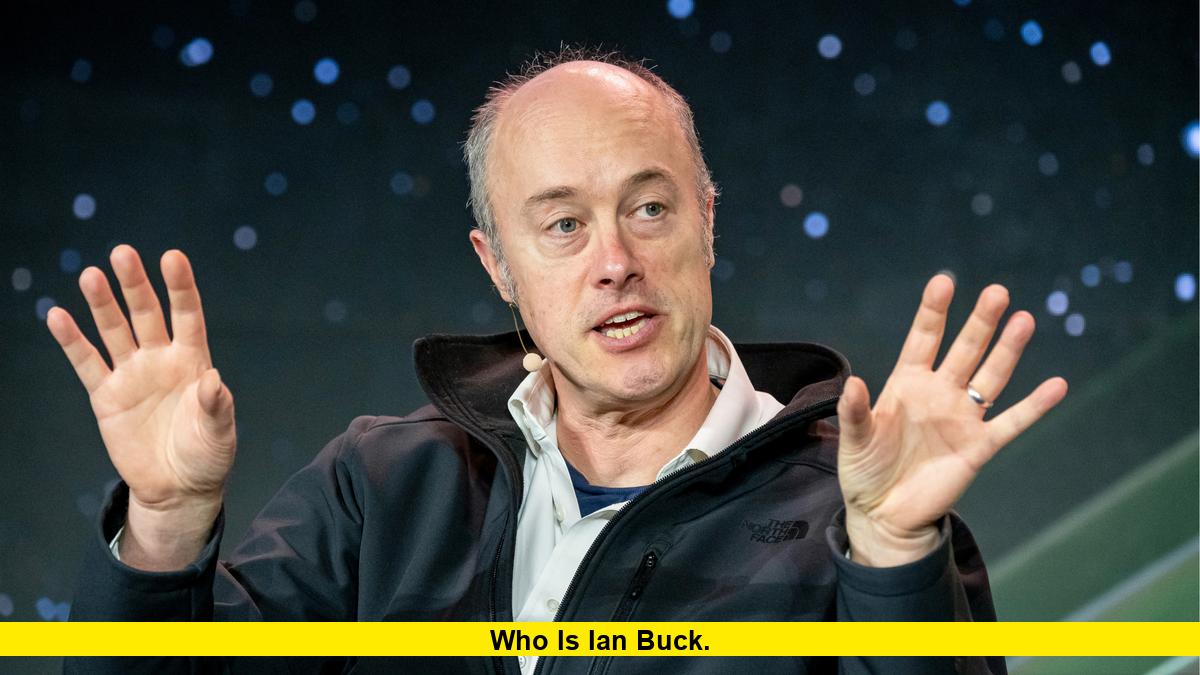
The question who is Ian Buck has attracted growing interest as NVIDIA continues to shape the global artificial intelligence industry. While CEO Jensen Huang frequently receives public attention for the company’s rapid growth, several technology executives have played important roles in developing the computing infrastructure behind its success. Ian Buck is one of them.
Buck is an influential NVIDIA executive, computer scientist, and a key figure in the development of CUDA, the programming platform that helped transform graphics processing units (GPUs) into powerful tools for scientific computing, artificial intelligence, and large-scale data processing. He currently serves as NVIDIA’s vice president of hyperscale and high-performance computing.
His professional journey connects academic research at Stanford University with the development of technologies that now support some of the world’s most advanced AI systems. His work has also brought him into discussions with U.S. policymakers about artificial intelligence, computing infrastructure, and America’s technological competitiveness.
Interest in Ian Buck NVIDIA has also generated questions about his personal wealth. However, unlike publicly traded company executives whose compensation is regularly disclosed, Buck’s exact net worth is not publicly established.
Here is what is known about his education, career, contribution to NVIDIA, leadership responsibilities, and estimated financial standing.
Who Is Ian Buck?
Ian Buck is an American computer scientist and senior technology executive at NVIDIA. He is best known for his contributions to GPU computing and his role in creating CUDA, a technology that allows developers to use graphics processors for tasks beyond traditional computer graphics.
He joined NVIDIA in 2004 after completing his doctoral studies in computer science at Stanford University. Before that, he earned an undergraduate degree in computer science from Princeton University.
His professional background combines software engineering, computer architecture, parallel computing, and product leadership.
Unlike executives whose careers primarily focus on business development or corporate management, Buck has a strong technical foundation. His research and engineering work helped establish an important connection between GPU hardware and general-purpose computing.
NVIDIA’s official biography identifies him as vice president of hyperscale and high-performance computing. In this position, he works on products and technologies supporting large-scale AI infrastructure and computing systems.
Ian Buck NVIDIA: What Is His Current Role?
Ian Buck holds a senior leadership position at NVIDIA, one of the most influential companies in the semiconductor and artificial intelligence industries.
His current title is Vice President of Hyperscale and High-Performance Computing.
He leads product efforts associated with hyperscale AI computing, working on NVIDIA hardware and software technologies that help major technology companies develop and deploy generative AI systems.
These responsibilities are increasingly important because AI development requires enormous computing resources. Companies building advanced AI models need powerful processors, interconnected computing systems, specialized software, and large data center infrastructure.
NVIDIA supplies many of these technologies.
Buck’s responsibilities involve working with major technology organizations, including Microsoft, Google, Amazon, Meta, and OpenAI, as they develop and deploy AI systems using NVIDIA technology.
His work is not limited to conventional GPU products. It also involves the broader computing infrastructure needed to operate AI applications at scale.
This includes the relationship between processors, software platforms, data center systems, and the applications that depend on accelerated computing.
Why Ian Buck Is Important to NVIDIA
NVIDIA’s position in the AI industry is built on more than the performance of its graphics processors.
Its software ecosystem has been equally important. CUDA is a central part of that ecosystem, and Buck played a foundational role in its development.
The technology allows programmers to use NVIDIA GPUs for computational tasks that traditionally depended heavily on CPUs.
This development helped NVIDIA expand beyond the gaming and graphics markets into scientific research, enterprise computing, financial services, engineering, and artificial intelligence.
Buck’s contribution is particularly significant because the demand for GPU computing has increased dramatically with the development of modern AI models.
His work helped establish software foundations that made GPU acceleration accessible to a much wider developer community.
Ian Buck and CUDA: The Technology That Changed GPU Computing
One of the most important reasons people search for Ian Buck is his connection to CUDA.
CUDA stands for Compute Unified Device Architecture. It is NVIDIA’s parallel computing platform and programming model, introduced in 2006.
Before CUDA became widely available, using graphics processors for general-purpose computing was considerably more difficult. GPUs were primarily associated with rendering graphics, processing images, and supporting video games.
Researchers recognized that GPUs could perform many calculations simultaneously, making them attractive for workloads involving large amounts of data.
However, developers needed better tools to take advantage of this processing power.
Buck helped address this challenge.
During his academic research at Stanford, he worked on Brook, a programming language and software system designed to make GPU computing more accessible.
Brook became an important predecessor to the broader development of general-purpose GPU computing.
After joining NVIDIA, Buck contributed to the development of CUDA, which gave programmers a more practical way to write applications that could use GPU processing capabilities.
Readers interested in the technical details can explore NVIDIA’s official CUDA Programming Guide.
How CUDA Supports Artificial Intelligence
CUDA is especially relevant to today’s AI industry because modern machine learning systems require extensive mathematical calculations.
Training an advanced AI model involves processing enormous quantities of data and performing repeated computational operations.
GPUs are well suited to many of these workloads because they can execute numerous operations in parallel.
CUDA provides the software environment that allows developers to access this capability.
Its applications extend across several industries:
- Artificial intelligence: Supporting the development and training of machine learning models.
- Scientific research: Accelerating simulations and complex mathematical calculations.
- Healthcare: Supporting computational research, medical imaging, and scientific analysis.
- Financial services: Helping process large datasets and computationally intensive models.
- Engineering: Improving simulation, design, and computational workflows.
- High-performance computing: Supporting research systems and large-scale computing environments.
CUDA has become a major part of NVIDIA’s competitive position because developers can build applications around an established software ecosystem rather than starting from scratch for every new GPU generation.
Buck’s contribution to this development is an important part of his professional legacy.
Ian Buck’s Education and Academic Background
Ian Buck’s education played a significant role in shaping his technology career.
He studied computer science at two highly regarded American universities: Princeton University and Stanford University.
Princeton University
Buck earned a Bachelor of Science in Engineering degree in computer science from Princeton University in 1999.
His undergraduate education provided the technical foundation for his later work in computer systems, programming languages, and GPU architecture.
Stanford University
After Princeton, Buck continued his academic career at Stanford University, where he completed a Ph.D. in computer science.
His doctoral research focused on stream computing and the use of graphics hardware for general-purpose computing.
His work involved developing Brook, a GPU streaming language that helped researchers explore ways to use graphics processors for applications beyond rendering.
This research became an important foundation for his later work at NVIDIA.
His academic background is particularly relevant because GPU computing was still developing as a research and engineering field when he began working on these technologies.
Ian Buck’s Career Before Becoming an NVIDIA Vice President
Buck’s professional experience includes research and engineering work that preceded his current executive responsibilities.
His early career involved several technology organizations and academic research projects.
His professional background includes:
- Silicon Graphics: Worked on graphics-related software and OpenGL technologies.
- Microsoft: Held an early program management position and later completed research work involving GPU implementations.
- Stanford University: Conducted research into stream computing and programmable graphics hardware.
- NVIDIA: Joined the company in 2004 and became closely associated with GPU computing software and CUDA development.
His earlier experience at Silicon Graphics and NVIDIA also gave him exposure to graphics programming and hardware performance optimization.
These experiences helped him develop the technical knowledge needed to work on GPU computing at a time when the technology was moving beyond traditional graphics applications.
Ian Buck’s Work With the U.S. Government on Artificial Intelligence
Buck’s influence extends beyond NVIDIA’s internal product development.
He has participated in discussions about the future of artificial intelligence and the role of advanced computing in American technological development.
On February 14, 2018, he testified before the U.S. House Committee on Oversight and Government Reform during a hearing focused on artificial intelligence.
At the time, he represented NVIDIA as its vice president and general manager of accelerated computing.
His testimony addressed how AI and accelerated computing could support important areas of the American economy.
These included:
- Cybersecurity and government data protection.
- Healthcare research and earlier disease detection.
- Transportation and autonomous vehicle development.
- Fraud detection and government efficiency.
- Defense maintenance and predictive analysis.
He also discussed the importance of government investment in AI research, adoption of AI technologies across federal agencies, and access to government data.
The testimony demonstrated that Buck’s expertise was relevant not only to the technology industry but also to discussions about America’s long-term AI capabilities.
His congressional appearance can be reviewed through the official U.S. House testimony document.
Ian Buck and America’s AI Infrastructure
Another important area of Buck’s work involves high-performance computing infrastructure.
As AI models become more sophisticated, companies and research institutions need increasingly powerful systems to train and operate them.
This creates demand for advanced GPUs, high-speed networking, specialized software, and large data centers.
Buck’s current leadership responsibilities place him in an important position within this industry.
His work also connects to the development of national AI supercomputers.
NVIDIA’s official biography describes his involvement in working with the United States and other countries on national AI supercomputing initiatives designed to advance scientific simulation and artificial intelligence.
These projects matter because AI infrastructure is increasingly connected to scientific research, industrial competitiveness, energy development, and national technology strategies.
For the United States, the ability to build and operate advanced computing systems is an important component of maintaining leadership in emerging technologies.
Ian Buck Net Worth: How Much Money Does He Have?
The search term Ian Buck net worth reflects growing interest in the financial position of senior NVIDIA executives.
However, there is no verified public figure establishing Buck’s personal net worth.
His exact wealth has not been publicly disclosed through a reliable financial statement, and there is insufficient verified information to calculate his total assets and liabilities.
Consequently, websites presenting a precise dollar amount as his confirmed net worth should be treated cautiously.
What Contributes to Ian Buck’s Potential Wealth?
Although his personal financial position is not publicly established, several factors are relevant when considering how a senior technology executive may accumulate wealth.
1. NVIDIA Executive Compensation
Buck’s senior leadership position at NVIDIA is an important part of his professional profile.
Executive compensation at major technology companies can include several components, such as base salary, annual performance bonuses, and long-term incentive awards.
However, his individual salary and compensation package should not be assumed without verified disclosures.
2. Potential Stock-Based Compensation
Stock awards are a common component of executive compensation in the technology sector.
For employees receiving equity awards, the eventual financial value can depend on the number of shares, vesting schedules, market prices, and applicable tax obligations.
NVIDIA’s growth has increased public interest in the potential financial benefits available to its senior employees.
Nevertheless, there is no publicly verified information establishing the exact number or value of NVIDIA shares personally owned by Buck.
3. Long-Term Career at NVIDIA
Buck joined NVIDIA in 2004 and has spent more than two decades associated with the company.
His long tenure and progression into senior leadership demonstrate his importance to the organization.
However, length of employment alone cannot establish personal wealth. A reliable calculation would require information about compensation, investments, equity ownership, property, other assets, and liabilities.
Is Ian Buck a Billionaire?
There is no credible public evidence establishing Ian Buck as a billionaire.
His senior position at NVIDIA and involvement in developing CUDA do not automatically mean that he owns a substantial percentage of the company.
A distinction must be made between professional influence, executive compensation, and personal ownership of corporate stock.
Without verified information about his holdings and assets, claims that he is a billionaire or has a specific multimillion-dollar fortune are unsubstantiated.
For readers researching Ian Buck net worth, the most accurate conclusion is that his personal fortune remains undisclosed.
Ian Buck Compared With Other NVIDIA Executives
NVIDIA is led by several prominent technology and business executives.
Jensen Huang, the company’s co-founder, president, and CEO, is the most recognizable public figure associated with its rise.
Other senior executives oversee different parts of NVIDIA’s business, including engineering, finance, software, and product development.
Buck’s position is distinctive because of his connection to GPU computing and the software infrastructure supporting AI development.
His career demonstrates how technical contributions can lead to major leadership responsibilities within a global technology company.
However, comparing his personal wealth with Jensen Huang’s publicly reported fortune would not be meaningful without reliable financial information about Buck.
What Is Ian Buck Doing Now? Latest Professional Developments
As of November 12, 2026, NVIDIA continues to identify Ian Buck as its vice president of hyperscale and high-performance computing.
His current professional focus is closely connected to the expansion of AI infrastructure.
NVIDIA’s AI ecosystem supports major cloud providers, technology companies, research organizations, and developers working on increasingly advanced applications.
Buck’s responsibilities involve managing product development for hyperscale AI and supporting partnerships that help organizations deploy these technologies.
His recent professional activity also reflects the growing importance of AI infrastructure beyond conventional cloud computing.
In May 2026, NVIDIA published an article about Buck’s participation in a discussion with U.S. Energy Secretary Chris Wright at the SCSP AI+ Expo.
The conversation focused on the Genesis Mission, a U.S. Department of Energy initiative aimed at applying AI to scientific discovery.
The discussion highlighted the relationship between AI computing, energy availability, scientific research, and American technological leadership.
This is an important area to watch because the expansion of AI infrastructure requires substantial investments in computing capacity and energy resources.
Why Are People Searching for Who Is Ian Buck?
There are several reasons behind the growing interest in his background.
First, NVIDIA has become central to the development of modern artificial intelligence. Its executives and technology leaders are attracting more attention as the company expands its influence.
Second, CUDA has become an important technology in the AI development ecosystem. People researching GPU computing frequently encounter Buck’s name because of his contribution to the platform’s development.
Third, his long career at NVIDIA raises questions about his compensation, professional achievements, and potential net worth.
Finally, his involvement in discussions with U.S. government officials has increased interest in his influence beyond the private technology sector.
For readers interested in the people responsible for building the infrastructure behind modern AI, Buck represents an important example of a computer scientist whose research developed into an influential industry technology.
Frequently Asked Questions About Ian Buck
1. Who is Ian Buck?
Ian Buck is a computer scientist and NVIDIA executive who serves as vice president of hyperscale and high-performance computing. He is also known for his foundational contributions to CUDA and GPU computing.
2. What is Ian Buck’s role at NVIDIA?
He is NVIDIA’s vice president of hyperscale and high-performance computing. His responsibilities include leading product efforts for hyperscale AI hardware and software.
3. Is Ian Buck the inventor of CUDA?
Buck is recognized by NVIDIA as an inventor of CUDA. He helped develop the technology after conducting pioneering GPU computing research at Stanford University.
4. What is Ian Buck’s net worth?
Ian Buck’s exact net worth has not been publicly verified. There is insufficient reliable information about his personal assets, stock ownership, investments, and compensation to establish a confirmed figure.
5. Where did Ian Buck study?
Buck earned a computer science degree from Princeton University in 1999 and completed a Ph.D. in computer science at Stanford University.
6. When did Ian Buck join NVIDIA?
He joined NVIDIA in 2004 after completing his doctoral studies at Stanford University.
7. Has Ian Buck testified before Congress?
Yes. He testified before the U.S. House Committee on Oversight and Government Reform on February 14, 2018, discussing artificial intelligence and accelerated computing.
8. Why is Ian Buck important to artificial intelligence?
His contributions to CUDA helped make GPU computing more accessible to developers and researchers. This technology became an important part of the computing ecosystem supporting modern AI.
Conclusion
Ian Buck is an important figure in NVIDIA’s history and the development of modern GPU computing. His academic research at Stanford, contributions to CUDA, and leadership in hyperscale and high-performance computing have helped shape technologies that support today’s artificial intelligence industry.
Although interest in Ian Buck net worth continues to grow alongside NVIDIA’s success, his personal fortune remains undisclosed, and no reliable public figure confirms his wealth.
His professional legacy is clearer than his financial profile: he helped establish technologies that transformed how computers handle demanding workloads, and his work continues to be relevant as AI infrastructure expands.
What do you think about Ian Buck’s contribution to NVIDIA and the future of artificial intelligence? Share your thoughts in the comments and stay tuned for more updates on influential technology leaders.