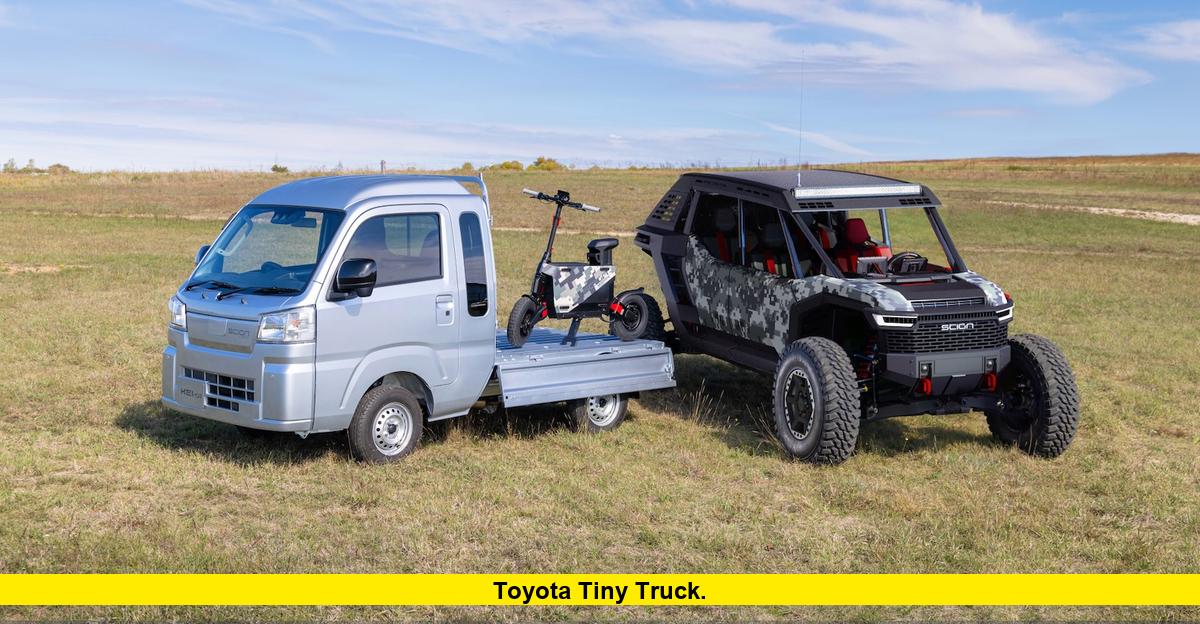
The Toyota tiny truck is becoming a reality in the United States, with Toyota unveiling the new KEI-01 ultra-compact utility truck for a planned U.S. arrival in the second half of 2027. The tiny pickup is designed for drivers and businesses that need a maneuverable work vehicle rather than a conventional highway-capable truck. Its small footprint, four-wheel drive, 660cc engine, and 25-mph maximum speed make it very different from the pickups Americans typically see on dealership lots.
Announced on November 10, 2026, the KEI-01 will launch through a limited fleet-focused program under Toyota’s revived Scion by Toyota brand. Initial customers are expected to include small businesses, farmers, ranchers, municipalities, universities, and delivery operators. Toyota has not announced U.S. pricing or confirmed widespread retail availability.
The announcement is significant for Americans interested in affordable mini trucks, compact utility vehicles, and Japanese-style kei trucks. However, prospective buyers should understand that the KEI-01 is intended for low-speed use, not ordinary highway driving.
What Is the Toyota KEI-01 Tiny Truck?
The KEI-01 is a Japanese-style mini utility truck being introduced to the U.S. market through Toyota’s new Scion by Toyota brand. Unlike traditional American pickups, which are built for a wide range of highway and hauling duties, this vehicle is designed around short-distance transportation, maneuverability, and practical everyday work.
Toyota’s announcement confirms that the KEI-01 will be assembled at its Indiana manufacturing facility beginning in the second half of 2027. The project includes a $34 million investment and approximately 50 additional jobs.
The truck’s small size is central to its purpose. Businesses that move supplies across large properties, campuses, farms, warehouses, or pedestrian-oriented commercial areas may benefit from a vehicle that can navigate tight spaces more easily than a full-size pickup.
For the official specifications and announcement, readers can visit the Toyota USA Newsroom.
Toyota Tiny Truck Specifications: What We Know So Far
Toyota has confirmed several important specifications for the KEI-01. Some purchasing details, however, remain unavailable.
| Feature | Confirmed details |
|---|---|
| Vehicle name | Scion KEI-01 |
| U.S. arrival | Second half of 2027 |
| Engine | 660cc three-cylinder |
| Transmission | Continuously variable transmission (CVT) |
| Drivetrain | Selectable four-wheel drive |
| Maximum speed | 25 mph |
| Length | Just over 11 feet |
| Width | Less than 5 feet |
| Maximum bed payload | Up to 600 pounds |
| Steering position | Right-hand drive |
| Cabin features | Heating, air conditioning, sliding and reclining seats |
| Cargo bed | Three-way fold-down sides |
| Initial availability | Limited fleet-focused pilot program |
| Assembly location | Toyota Indiana |
| U.S. price | Not announced |
These specifications make the KEI-01 a specialized utility vehicle rather than a direct replacement for a conventional pickup. Its payload is suitable for some light-duty tasks, but businesses that regularly transport heavy equipment or bulky materials will need to evaluate their requirements carefully.
How Small Is the Toyota Tiny Truck?
The KEI-01 measures just over 11 feet long and less than 5 feet wide. That compact footprint makes it substantially smaller than the pickups commonly sold in the United States.
Its narrow body is intended to make maneuvering through confined work areas easier. For example, an operator moving supplies around a university campus or transporting tools between buildings may find a compact truck more convenient than a larger commercial vehicle.
The small dimensions could also help businesses working in crowded service areas, storage facilities, and agricultural properties.
However, a compact exterior does not automatically make the vehicle suitable for every job. Buyers will need to consider cargo dimensions, payload limits, trailer requirements, road conditions, and the distances the vehicle must travel.
Engine, Transmission, and Four-Wheel-Drive Capability
The Toyota tiny truck uses a 660cc three-cylinder engine paired with a continuously variable transmission. It also comes with selectable four-wheel drive, including an automatic mode and a locking function.
This configuration is designed to support low-speed utility work rather than high-speed performance.
Four-wheel drive may be useful when moving across uneven ground, muddy paths, or snow-covered work areas. However, actual capability depends on surface conditions, tires, vehicle loading, and other operating factors.
Toyota has not announced a U.S. fuel-economy rating, official horsepower figure, or detailed acceleration figures for the KEI-01. Buyers should not assume that Japanese-market specifications or estimates circulating online will necessarily apply to the U.S.-assembled version.
The vehicle’s 25-mph maximum speed is a more important consideration for prospective U.S. operators than its small engine alone.
Cargo Bed, Payload, and Practical Utility
Despite its miniature dimensions, the KEI-01 has several features intended to make routine work easier.
Its three-way fold-down cargo bed allows the sides to lower, creating easier access for loading and unloading supplies. This arrangement can be particularly useful for carrying boxes, landscaping materials, maintenance equipment, and other relatively lightweight items.
Toyota lists a maximum bed payload of 600 pounds. That figure should be treated as a limit, not a recommended target for every trip. Operators must account for the weight of the cargo and follow the manufacturer’s final loading instructions.
The extended cabin also offers storage behind the seats, giving workers a place to secure tools and smaller equipment.
Heating and air conditioning are included, an important feature for businesses that need enclosed-cabin comfort in different weather conditions.
Toyota has also described the vehicle as capable of towing small trailers and equipment, but it has not announced a specific U.S. towing-capacity rating. Buyers should wait for the final towing specifications before planning to pull a loaded trailer.
Is the Toyota Tiny Truck Street Legal in the United States?
This is one of the most important questions for anyone interested in the KEI-01.
Toyota says the vehicle is designed to comply with applicable federal safety requirements for low-speed vehicles, including Federal Motor Vehicle Safety Standard No. 500. Its maximum speed will be limited to 25 mph.
That classification is fundamentally different from the regulatory category used by ordinary highway-capable pickups.
Federal low-speed vehicle standards and local operating rules determine where vehicles in this category may be used. State and local requirements can affect registration, permitted roads, equipment, and other conditions.
Readers can review the federal framework through the National Highway Traffic Safety Administration’s low-speed vehicle guidance.
The key distinction is that the KEI-01 is not intended for normal highway travel. Its 25-mph maximum speed makes it unsuitable for most interstate and high-speed road journeys, regardless of whether it can be legally operated on certain public roads.
Before purchasing or operating one, businesses should verify applicable state and local rules and determine whether the intended routes permit low-speed vehicles.
When Will the Toyota Tiny Truck Be Available?
Toyota has announced a planned U.S. arrival in the second half of 2027.
The initial rollout will be a limited, fleet-focused pilot program. Selected dealers within Toyota’s existing dealer network will serve as the customer-facing sales channel for the new Scion by Toyota brand.
The pilot approach allows Toyota to evaluate how the vehicle performs in actual work environments and how well it meets the needs of commercial customers.
It also means that individual consumers should not assume they will be able to walk into a Toyota dealership and purchase one when production begins.
Toyota has said it may consider limited retail sales later, depending on market conditions, customer demand, and operational considerations. That is a possibility, not a confirmed retail launch.
As of the latest announcement, Toyota has not provided a final U.S. price, a detailed trim lineup, or a specific date for customer deliveries.
How Much Will the Toyota Tiny Truck Cost?
Toyota has not announced the U.S. starting price for the KEI-01.
Its compact design and fleet-focused purpose may make it attractive to businesses seeking a smaller alternative to conventional commercial vehicles. Nevertheless, an official price is necessary before buyers can determine whether it will deliver meaningful savings.
The final cost could include more than the vehicle’s advertised purchase price. Businesses should also consider insurance, registration, maintenance, charging or fueling arrangements where applicable, and any equipment needed for their operations.
Fleet customers may also need to account for delivery, service support, replacement parts, and downtime.
Online estimates suggesting a specific price should be treated as speculation until Toyota publishes official pricing. There is currently no confirmed U.S. MSRP for the KEI-01.
Who Should Consider Buying the Toyota Tiny Truck?
The KEI-01 is aimed at customers whose transportation needs fit a small, low-speed work vehicle.
- Small businesses: Retailers, maintenance teams, and service operators may use it to move supplies across private properties or between nearby work areas.
- Farmers and ranchers: The compact dimensions and four-wheel drive could be useful for certain light-duty tasks on farms and ranches.
- Universities and colleges: Facilities teams could use the truck to transport tools, equipment, and supplies across large campuses.
- Municipalities: Local government departments may find it useful for selected maintenance and service operations.
- Delivery and service fleets: Businesses operating in restricted areas or on private roads could benefit from its maneuverability.
- Large commercial properties: Warehouses, resorts, industrial campuses, and similar facilities may find applications for short-distance transportation.
The vehicle will be less suitable for customers who need to carry heavy loads, tow substantial trailers, travel long distances on public roads, or commute at normal traffic speeds.
Toyota Tiny Truck vs. Toyota Tacoma
The KEI-01 and the Toyota Tacoma serve very different purposes.
The Tacoma is a conventional midsize pickup designed for broader transportation needs, including highway driving and more demanding hauling applications. The KEI-01 is a low-speed utility truck built for specialized work environments.
| Category | KEI-01 | Toyota Tacoma |
|---|---|---|
| Primary purpose | Low-speed utility work | General-purpose pickup use |
| Maximum speed | 25 mph | Highway-capable |
| Engine | 660cc three-cylinder | Conventional truck powertrain options |
| Drivetrain | Selectable four-wheel drive | Configuration-dependent |
| Payload | Up to 600 pounds in the bed | Varies by configuration |
| Highway use | Not intended for normal highway travel | Designed for public-road travel |
| Initial U.S. availability | Limited fleet pilot planned | Established retail model |
Drivers who need a traditional pickup for everyday travel should explore the official Toyota Tacoma lineup. The KEI-01 is better understood as a specialized tool for particular commercial environments, not a smaller version of the Tacoma with equivalent capabilities.
How Does the Toyota Tiny Truck Compare With the Ford Maverick?
The Ford Maverick is another vehicle worth considering for buyers interested in smaller pickups, but it belongs to a different category.
The Maverick is designed for conventional road use and offers a more familiar pickup format for drivers who need to commute, carry equipment, and travel between job sites.
The KEI-01 prioritizes compact dimensions and low-speed operation. It could be useful for work within a confined area, but it cannot perform the same transportation role as a highway-capable compact pickup.
Potential buyers should compare the vehicles according to their intended use rather than size alone.
For current model information, see the official Ford Maverick lineup.
A business operating a fleet across a large property may have different needs from a contractor who travels between multiple towns each day. The right vehicle depends on the routes, load requirements, operating costs, and applicable vehicle regulations.
Is the Toyota Tiny Truck the Same as the Toyota Stout?
No. The newly announced KEI-01 should not be confused with speculation about a future compact Toyota pickup sometimes called the Stout.
The Toyota Stout was a historical light-truck nameplate, and online discussions have frequently used the name when speculating about a smaller modern Toyota pickup for North America.
However, Toyota’s latest announcement identifies the new mini utility truck as the Scion KEI-01. It does not establish that the vehicle is a new Toyota Stout or that Toyota has confirmed a production model under that name.
The KEI-01 also differs from the concept of a conventional compact pickup intended to compete directly with vehicles such as the Ford Maverick. Its low-speed classification, 25-mph limit, and initial fleet-focused availability set it apart.
Readers should be cautious about online posts advertising a confirmed future Toyota Stout with a specific model year, price, or engine configuration unless Toyota provides supporting details.
Why Is Toyota Bringing a Kei Truck to America?
The announcement reflects an effort to explore a category of vehicle that has long been popular in Japan but occupies a much smaller role in the U.S. market.
Kei vehicles are designed around compact dimensions and small engines. Their practical appeal comes from using less space and meeting transportation needs without the size of a conventional car or truck.
In the United States, there may be opportunities for this approach in environments where a vehicle does not need to travel at highway speeds.
The KEI-01’s planned assembly in Indiana also gives Toyota a way to introduce the concept through an American manufacturing operation. The announced investment and additional jobs form part of that project.
Reviving Scion as Scion by Toyota provides a separate identity for this experiment. Toyota describes the brand as a place to explore new ideas in utility, mobility, and personal expression.
The initial rollout will help determine whether the KEI-01 has a sustainable role in American commercial operations and whether broader availability makes sense.
What Should Buyers Watch Before the 2027 Launch?
Several unanswered questions will determine the vehicle’s practical appeal.
1. Official pricing: Toyota needs to announce the purchase price before businesses can compare it with other work vehicles.
2. Fleet availability: The company has not published the full list of participating dealerships, ordering procedures, or allocation details.
3. State and local regulations: Operators should determine where low-speed vehicles can legally travel and whether their intended routes are suitable.
4. Final operating specifications: Fuel economy, maintenance requirements, towing limits, warranty details, and other ownership information will matter to commercial buyers.
5. Retail availability: Toyota may expand sales beyond fleet customers, but it has not committed to a broad consumer launch.
6. Service and parts support: Businesses should understand how routine maintenance, repairs, and replacement parts will be handled before incorporating the truck into daily operations.
These details will be particularly important for customers deciding whether to replace existing utility vehicles or add the KEI-01 to a commercial fleet.
Final Takeaway
The Toyota tiny truck represents a different approach to utility transportation in the United States. With its compact dimensions, four-wheel drive, fold-down cargo bed, and 25-mph speed limit, the KEI-01 is designed for specialized work rather than conventional pickup duties. Its planned 2027 arrival gives businesses time to assess their needs, but pricing, final purchasing arrangements, and potential consumer availability remain important unanswered questions.
Would you consider a Toyota tiny truck for your business, farm, or property, or would you prefer a conventional pickup? Share your thoughts and stay tuned for the latest KEI-01 updates.