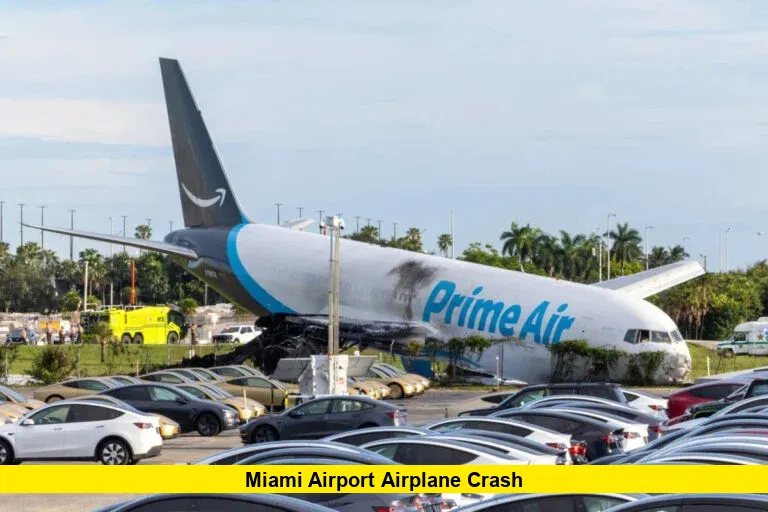
The miami airport airplane crash has drawn renewed attention to aviation safety at Miami International Airport (MIA) following two separate incidents in 2026: a deadly cargo aircraft runway accident in September and a collision between two commercial aircraft on November 14. The incidents have raised important questions about airport operations, runway safety, aircraft movements, and the ongoing federal investigations.
The September accident involved a Boeing 767 cargo aircraft operated by 21 Air on behalf of Amazon. The plane overran a runway after landing and struck two vehicles, resulting in five deaths and multiple injuries. More recently, a Copa Airlines Boeing 737 and a UPS Boeing 767 made contact while taxiing at the airport, although officials initially reported no injuries requiring hospital transportation.
These were separate aviation incidents with different circumstances. Understanding what happened, what investigators have established, and whether airport operations have been affected is essential for travelers, airline customers, and Miami residents.
Latest Miami Airport Airplane Crash: What Happened on November 14, 2026?
The latest incident occurred at approximately 9:15 p.m. local time on Saturday, November 14, 2026, when two Boeing aircraft collided while moving along taxiways at Miami International Airport.
The aircraft involved were:
- Copa Airlines Boeing 737: The passenger aircraft was taxiing toward its assigned gate after arriving from Panama City, Panama.
- UPS Boeing 767: The cargo aircraft was preparing to depart Miami for Bogotá, Colombia, as UPS Flight 358.
According to the Federal Aviation Administration (FAA), the wingtip of the Copa Airlines Boeing 737 struck the nose of the UPS Boeing 767.
The FAA also confirmed that air traffic controllers had instructed the UPS crew to give way to the Copa aircraft.
The collision occurred at the intersection of two taxiways. It was a ground collision, not an aircraft crash during takeoff or landing.
Two people received treatment for minor injuries at the scene, according to reporting that cited Miami-Dade Aviation officials. They did not require transportation to a hospital.
The incident damaged the aircraft and prompted an investigation by federal aviation authorities.
Were Airport Operations Disrupted?
The initial response from Miami International Airport indicated that the collision did not significantly affect airport operations.
Airport officials said aircraft were being directed to alternative taxiways while emergency personnel and airport teams addressed the incident.
This distinction matters because the collision happened on the airport’s ground movement network rather than on an active runway. Redirecting aircraft through other taxiways helped limit immediate operational disruption.
Nevertheless, travelers should not assume that every flight operated normally that evening. Miami was also dealing with wider U.S. aviation disruptions following a nationwide FAA ground stop on November 13.
That separate air traffic control disruption contributed to flight delays and cancellations across the country.
Passengers traveling through Miami should check their individual flight status rather than relying on general reports about airport operations.
September 6, 2026: The Deadly Miami International Airport Cargo Plane Crash
Although the November collision attracted considerable attention, the more serious accident occurred on September 6, 2026.
On that Sunday afternoon, 21 Air Flight 7598, a Boeing 767-33A cargo aircraft, overran Runway 30 at Miami International Airport after arriving from Luis Muñoz Marín International Airport in San Juan, Puerto Rico.
The aircraft was operating a cargo flight on behalf of Amazon.com Services LLC.
After leaving the paved runway, the airplane crossed the airport perimeter and struck two passenger vehicles on the ground.
The resulting accident caused a devastating loss of life.
According to the National Transportation Safety Board’s investigation:
- Five people on the ground died.
- Three people on the ground sustained serious injuries.
- Both pilots sustained minor injuries.
- The aircraft suffered substantial damage.
- A post-crash fire developed on the airplane’s right wing.
The accident became one of the most significant aviation safety incidents involving Miami International Airport in 2026.
Unlike the November taxiway collision, the September accident involved an aircraft that had just landed and continued beyond the runway.
What Caused the September Miami Airport Airplane Crash?
Determining the cause is one of the most important parts of the ongoing NTSB investigation.
Investigators have examined flight recorder information, cockpit communications, aircraft performance, landing procedures, and the circumstances surrounding the runway overrun.
The preliminary findings provide important information about the aircraft’s final approach and landing.
However, they should not be interpreted as a final determination of responsibility.
Cockpit Recordings Reveal Concerns About Aircraft Speed
One significant detail emerged from the cockpit voice recorder.
According to the NTSB’s September 9 investigative update, one pilot cautioned the other that the aircraft was traveling too fast during the landing approach.
The recording also captured additional comments about excessive speed during the final portion of the flight.
The investigators documented several other cockpit warnings, including electronic alerts relating to sink rate and terrain.
A pilot also called for a go-around shortly before the recording ended.
These details are important because they help investigators reconstruct the final moments before the aircraft left the runway.
However, a cockpit warning alone does not establish why the accident occurred or whether a particular action caused it.
Flight Data Recorder Provides Important Evidence
The NTSB recovered both the cockpit voice recorder (CVR) and flight data recorder (FDR).
The agency successfully downloaded their information for further examination.
The flight data recorder contained approximately 54 hours of recorded information covering more than 400 parameters.
Some of the preliminary findings included:
- The aircraft’s nose and right main landing gear touched down at a recorded groundspeed of 158 knots.
- Brakes were applied when the aircraft was traveling at approximately 146 knots.
- The left main landing gear touched down at approximately 134 knots.
- The brakes were subsequently released, and engine power increased to a level consistent with go-around thrust.
- The throttles were later reduced to idle, and the brakes were applied again.
- The final recorded groundspeed was 65 knots.
The NTSB also reported that the recorded data did not indicate deployment of speed brakes or thrust reversers.
These findings are preliminary. Investigators must evaluate the information alongside other evidence before reaching conclusions about the accident.
Why a Runway Overrun Can Become So Dangerous
A runway overrun happens when an aircraft cannot stop within the available runway distance and continues beyond the paved surface.
Several factors can influence the outcome, including:
- Aircraft speed at touchdown.
- Landing position and remaining runway distance.
- Aircraft weight and braking performance.
- Weather and runway surface conditions.
- Pilot decisions during the landing sequence.
- Availability and effectiveness of runway safety areas.
A runway overrun does not automatically mean that an aircraft will experience a catastrophic accident.
However, the Miami incident demonstrated the potentially devastating consequences when an aircraft continues beyond the runway and encounters vehicles or other obstacles.
The investigation will help establish which factors were relevant to this particular accident.
What the NTSB Has Confirmed About the Investigation
The National Transportation Safety Board is leading the investigation into the September runway accident.
The investigation involves several organizations, including:
- Federal Aviation Administration.
- Boeing.
- General Electric Aerospace.
- 21 Air.
- Miami-Dade Aviation Department.
- National Air Traffic Controllers Association.
- 21 Air Pilots Association.
The participation of these organizations allows investigators to examine different aspects of the accident, including aircraft systems, flight operations, airport infrastructure, and air traffic control procedures.
Readers can follow the agency’s official 21 Air Flight 7598 investigation and preliminary findings for developments.
The investigation remained ongoing as of November 15, 2026. A final determination of the accident’s cause should not be assumed until the NTSB completes its work and publishes its findings.
What Is Known About the November UPS and Copa Airlines Collision Investigation?
The November 14 incident presents a different set of investigative questions.
Unlike the September runway overrun, the latest collision involved two aircraft that were taxiing on the ground.
The FAA confirmed that air traffic controllers had instructed the UPS aircraft to give way to the Copa Airlines jet.
Investigators will need to establish how the aircraft approached the taxiway intersection, what instructions were communicated, how those instructions were understood, and why physical contact occurred.
Important questions include:
- Were the aircraft following their assigned taxi routes?
- Were the pilots able to see the other aircraft clearly?
- Did the aircraft receive and follow the correct ground movement instructions?
- Was there sufficient clearance between the two aircraft?
- Could airport ground traffic procedures be improved to prevent similar incidents?
These are investigative questions, not established findings.
The FAA has confirmed that it is investigating the collision. As of November 15, a final explanation of what caused the contact had not been announced.
The agency’s official aviation accident and incident updates provide information about both current and developing aviation investigations.
Miami International Airport Runway Closures and Recovery After the September Accident
The September runway overrun also created operational challenges for Miami International Airport.
Following the accident, investigators needed access to the affected area to document the aircraft, collect evidence, and examine the surrounding scene.
As a result, airport runway availability was temporarily reduced.
In the immediate aftermath, Miami-Dade officials reported that two of the airport’s four runways remained closed while investigators continued their work.
The restrictions affected airport operations and created additional challenges for travelers.
Airport authorities and emergency response teams worked alongside federal investigators to manage the situation.
An additional runway was returned to service during the early recovery period, helping improve airport capacity.
By September 15, Miami-Dade officials reported that the damaged aircraft had been removed from the crash site and relocated to an open lot south of the original location.
This was an important step in the physical recovery process.
However, removing the aircraft and reopening airport infrastructure did not mean the investigation had concluded.
The distinction between restoring airport operations and completing a safety investigation is important. An airport can return to normal operations while federal investigators continue examining an accident for months.
What the Miami Airport Incidents Mean for Travelers
The two incidents have understandably raised concerns among passengers who use Miami International Airport.
MIA is a major international gateway connecting the United States with Latin America, the Caribbean, Europe, and other destinations.
Consequently, operational disruptions can affect passengers beyond South Florida.
Travelers should understand that an aircraft collision on a taxiway does not automatically mean that the entire airport must close.
Similarly, a runway accident does not necessarily result in permanent changes to every flight operating at the airport.
The actual effect depends on the location of the incident, runway and taxiway availability, emergency response requirements, and decisions made by airport authorities.
Passengers traveling through Miami should take the following precautions:
- Check flight status directly with the airline before leaving for the airport.
- Monitor departure and arrival updates through the airline’s mobile application.
- Allow additional time for airport transportation and security procedures.
- Contact the airline if a delay or cancellation affects a connecting flight.
- Follow airport instructions concerning terminal access and ground transportation.
The official Miami International Airport flight information page provides access to arrivals, departures, and flight-tracking information.
Airline-specific updates remain particularly important because a general airport operating status cannot confirm whether an individual flight is departing on schedule.
Could the Miami Airport Airplane Crash Affect Future Aviation Safety Rules?
The two incidents may lead to additional scrutiny of different aspects of airport safety.
The September runway overrun raises questions about aircraft landing performance, runway safety areas, emergency response, and procedures for preventing aircraft from leaving paved surfaces.
The November collision raises a separate set of questions involving taxiway clearance, ground movement coordination, and communication between pilots and air traffic controllers.
These issues are relevant to airports throughout the United States, not just Miami.
Runway Safety Improvements
Runway safety is an important part of commercial aviation operations.
Airports and aviation authorities use several measures to reduce the risk of runway overruns, including:
- Runway safety areas designed to reduce consequences when an aircraft leaves the runway.
- Runway condition monitoring and reporting.
- Aircraft braking and performance assessments.
- Pilot training for rejected landings and go-around decisions.
- Airport emergency response planning.
Whether the Miami accident results in additional recommendations will depend on the NTSB’s final findings.
Taxiway Safety and Ground Traffic Management
The November collision also highlights the importance of safe aircraft movement when multiple planes are operating near gates and taxiway intersections.
Air traffic controllers issue instructions to coordinate aircraft movement, but safe ground operations also depend on pilots understanding and following those instructions.
Potential areas of review include taxiway markings, aircraft clearance procedures, ground traffic coordination, and communication practices.
Any changes resulting from the investigation would need to be supported by the findings rather than assumptions about what happened.
Miami-Dade Officials Respond to the Aviation Incidents
Miami-Dade County officials expressed condolences following the September tragedy and acknowledged the work of emergency responders.
The local response involved Miami-Dade Fire Rescue, law enforcement personnel, airport staff, and other emergency teams.
According to Miami-Dade Mayor Daniella Levine Cava’s September 7 statement, firefighters reached the accident scene in less than 30 seconds.
Emergency personnel worked to control the fire, assist injured individuals, and support the recovery operation.
County officials also emphasized their cooperation with federal investigators.
The county’s public communications provide additional information about the local response and airport recovery. Readers can review the Miami-Dade mayor’s statement following the September Miami airport accident for further details.
For residents living near Miami International Airport, the incidents also highlight the importance of airport perimeter safety and coordination between aviation authorities and surrounding communities.
Is Miami International Airport Safe for Flights?
The incidents have understandably prompted questions about whether passengers should be concerned about flying through Miami.
It is important to distinguish between an individual accident and the overall safety of an airport.
The September accident involved a cargo aircraft that overran a runway. The November incident involved two aircraft making contact while taxiing.
Neither event, by itself, establishes that all flights operating at Miami International Airport are unsafe.
Commercial aviation operates under federal safety regulations, and airlines, airports, pilots, and air traffic controllers have established procedures intended to prevent accidents.
When incidents occur, the FAA and NTSB investigate to identify what happened and whether additional safety measures are necessary.
Passengers should continue following official travel advisories and airline instructions.
There is no basis for assuming that every aircraft operating through Miami faces the same circumstances as the planes involved in these incidents.
What Happens Next in the Miami Airport Investigations?
The next important developments will come from the federal investigations.
For the September 6 accident, investigators must complete their examination of flight data, cockpit recordings, aircraft systems, landing performance, and other relevant evidence.
For the November 14 collision, the FAA will examine the circumstances surrounding the taxiway contact between the Copa Airlines and UPS aircraft.
Several developments will be particularly important to watch.
1. Additional FAA findings
The FAA’s investigation may clarify how the November collision occurred and whether changes to ground movement procedures are necessary.
2. Further NTSB investigative updates
The NTSB may release additional information about the September runway accident as its investigation progresses.
3. Final accident findings
A final NTSB report will be important for understanding the probable cause of the September tragedy and any safety recommendations arising from it.
4. Possible airport safety changes
Miami-Dade Aviation Department and federal authorities may consider additional safety measures if investigators identify specific risks that require attention.
None of these potential developments should be treated as confirmed until the responsible agencies announce them.
Frequently Asked Questions About the Miami Airport Airplane Crash
1. What happened in the Miami airport airplane crash?
There were two separate major aviation incidents in 2026. On September 6, a 21 Air Boeing 767 cargo aircraft overran a runway at Miami International Airport and struck two ground vehicles, killing five people. On November 14, a Copa Airlines Boeing 737 and a UPS Boeing 767 collided while taxiing.
2. Was anyone killed in the November 14 Miami airport collision?
No deaths were reported in the November 14 taxiway collision. Two people received treatment for minor injuries at the scene and did not require hospital transportation.
3. How many people died in the September Miami airport crash?
Five people on the ground died in the September 6 accident. Three other people on the ground sustained serious injuries, while the two pilots sustained minor injuries.
4. Which airline was involved in the September Miami airport crash?
The aircraft was operated by 21 Air as Flight 7598 on behalf of Amazon.com Services LLC. It was a Boeing 767-33A cargo aircraft arriving from San Juan, Puerto Rico.
5. Which planes collided at Miami International Airport in November?
A Copa Airlines Boeing 737 and a UPS Boeing 767 made contact while taxiing on November 14, 2026. The Copa aircraft was heading toward its gate, while the UPS aircraft was preparing to depart for Bogotá, Colombia.
6. What caused the September Miami airport airplane crash?
The final cause has not been established. Preliminary NTSB findings identified excessive-speed concerns in the cockpit recording and documented the aircraft’s landing and braking sequence. Investigators must evaluate all relevant evidence before determining the probable cause.
7. Is the FAA investigating the November Miami airport collision?
Yes. The FAA confirmed that it is investigating the November 14 collision involving the Copa Airlines and UPS aircraft.
8. Is Miami International Airport open after the incidents?
The incidents did not result in a permanent airport closure. The September accident temporarily affected runway availability, while airport officials initially reported that the November taxiway collision did not affect overall airport operations.
9. Where can passengers check Miami airport flight delays?
Passengers can check the official Miami International Airport flight information page or contact their airlines directly for the latest departure, arrival, cancellation, and rebooking information.
10. When will investigators release the final findings?
There is no confirmed publication date for the final findings of the September accident investigation. The FAA has also not announced a final conclusion regarding the November taxiway collision.
Final Takeaway: Miami Airport Airplane Crash Remains an Important Aviation Safety Story
The two Miami International Airport incidents in 2026 demonstrate why runway safety and aircraft ground movement procedures remain critical priorities for the aviation industry.
The September 6 cargo plane accident resulted in five deaths and serious injuries, while the November 14 collision between Copa Airlines and UPS aircraft brought renewed attention to airport taxiway safety.
Although the incidents involved different circumstances, both deserve careful investigation and transparent communication from aviation authorities.
The most important developments ahead will be the FAA’s findings on the November collision and the NTSB’s continuing investigation into the September tragedy.
What are your thoughts on the recent Miami airport aviation incidents? Share your views in the comments and follow the latest updates as investigators work to establish what happened.